Sunday, November 12, 2017

Sumac Tea or Sumac-Ade - Easy Pickings for a Seasonal Treat

Sumac Tea or Sumac-Ade
Easy Pickings for a Seasonal Treat


Whether it is the dry summer or the more ominous signs of a changing climate the autumn colors have passed without fanfare.

Nevertheless there is one treat that I always look forward to in the fall that is almost assured irrespective of the weather, Sumac tea or served up ice cold as sumac-ade.


No doubt you've seen them before. Sumac is a plant that grows wild all over New Hampshire. It will grow in places where it seems inhospitable to almost any plant. And it makes a great tea or “lemon”ade from late fall right on through spring when the old clusters dry out and are replaced with new ones that will be tasteless until the end of summer. They are best in the late fall because it takes fewer of the flowerheads to make a robust drink.


There are several species of sumac but you want the Staghorn or Smooth Sumac variety for your tea. Its upright cluster of red seeds are easily spotted.  The Staghorn has a distinctive velvety feel on the newer growth, like a deer’s antlers in early spring, a sure sign that you are using the correct sumac.


If you are nervous about this because you may have heard of Poison Sumac, don't be. Poison Sumac is actually much more rare in New Hampshire and has white berries that droop. It is impossible to mistake for the more common Sumac varieties.


Making Sumac-ade is quite easy. Gather a grocery size bag of the clusters. Take a large pot and fill it with fresh water and put the clusters right into the water. Wash your hands and then rinse them well to be sure you’ve gotten all the soap off, crush the clusters until they break apart in the water and allow them to steep for an hour or two. Drain the liquid through cheesecloth or some other clean, disposable cloth, toss the clusters in your compost pile, add sweetener to taste (for lemonade) and voila!.


If you’d prefer it as tea, you can do all the above and then heat the liquid though you need not go through the process above but can steep a hand full of the seeds in hot water for just a few minutes and sweeten as you like it. You can also hang the pods to dry and store them for later.


It’s a very nice change from all of the commercially available drinks and a refreshing fall favorite in our home.


Wayne King's regular column, "The View from Rattlesnake Ridge" is a reflection of the meanderings and musings of the artist, author and activist.


Sumac Moon

Asquamchumaukee - Place of Mountain Waters - Along the Baker River in NH

Asquamchumaukee 
Place of Mountain Waters

A photographic ramble through the Baker River Valley of New Hampshire


King Releases Photographic Book of Baker River Valley
Asquamchumaukee - Place of Mountain Waters

Rumney, NH . . .New Hampshire photographer and artist, and former Senator Wayne D. King has released an art book of images captured along the Baker River Valley entitled: Asquamchumaukee - Place of Mountain Waters. The title, taken from the Pemigewasset Indian name for the Baker River and the valley through which it flows, harkens back to the artist’s own Native American heritage.

King created the book at the urging of friends who had seen a collection of his images from the region and indicated that they would have an interest in a book that included the images. “ I wanted to make the book one that would both share the images of the area and serve a larger purpose as well.  We came up with the idea of creating a large format book, printed on high quality paper in a signed limited edition that could be sold to raise funds for local "Got Lunch!" programs in the Baker River Valley.”


"Got Lunch!" provides nutritious lunches for children who qualify for the free school lunch program; providing them with nutritious meals during the summer when the program does not cover them. 

Only 250 copies of the hard-cover limited edition, fine art book is printed and numbered and signed by the artist. 


The book is also available in an open edition (unsigned) in four different sizes and styles: a large format open edition, a standard size (8”x10”) in both hard-cover and soft-cover, and an eBook. “The hope was that we could create a way for anyone to participate in helping the “Got Lunch!” program by creating a wide range of options for purchasing the book.” said King.

In addition to the books, King has also made cards, posters and prints of many of the individual images from the book available to benefit “Got Lunch!”. There are also a number of mugs, tote bags and clocks made using the images from “Asquamchumaukee”.

“The book or product created from an image in the book would make a great Christmas or Holiday gift” said King. “For those who purchase the book as a gift for someone else, we will also provide a free gift card of the cover image telling them that the proceeds from the book will be providing nutritious meals for deserving children.”


King’s images are a celebration of life, blending the real and the surreal to achieve a sense of place or time that reaches beyond the moment into what he calls a “dreamlike quintessentialism” designed to spark an emotional response. Using digital enhancement, handcrafting, painting, and sometimes even straight photography, King hopes to take the viewer to a place that is beyond simple truth to where truth meets passion, hope and dreams.

As with most of King’s images, only one original signed print is available but open edition fine art prints, posters and greeting cards are also offered as an affordable alternative for people who love art for the pure joy of it and don’t require a signed original.


Book Description

In the heart of New Hampshire, the geographic center of the state, is a beautiful meandering river that is the focal point of a very special community of people and a landscape that grows into the heart like a spreading wildfire. The Baker River, called Asquamchumaukee by the original natives of the region, is an archetype of a river,  beginning with the fast flowing waters of the Moosilaukee region and ending in broad lugubrious oxbows where it meets the Pemigewasset River.  Anyone who has canoed the Baker or climbed Rattlesnake Mountain or hiked Mount Cube; anyone who has bicycled or driven along the Buffalo Road, can't help but fall in love with this area. 
If the landscape isn't enough the people will seal the deal: pragmatic, serious-minded in their politics, and deeply devoted to their families; people who work hard, play hard and who immerse themselves joyfully in the life of their community and the other communities of the valley. 

In that spirit, a portion of the proceeds from sales of this book will benefit the local "Got Lunch!" programs in the Valley. 

“Got Lunch!” provides nutritious lunches for children who qualify for the Federal free lunch program but who are not provided with meals during the summer vacation. “Got Lunch!” assures that the children of the Baker River Valley will return to school, ready and able to learn and unhampered by the challenges of poor nutrition. 

This book and the images from it are available in a number of different formats including a large landscape hardcover, signed and numbered, limited edition art book; an open edition in hardcover, softcover and eBook formats as well as other related products including calendars, clocks, mugs, cards, posters and prints.


Signed, Numbered Limited Edition - Large Format
Hardcover 13” x 11” 
42 Pages printed on Proline Pearl Photo Paper
Hardcover with Dust Jacket: $165.00
Hardcover with Image Wrap Cover: $175.00
Shipping & Handling: $10.00


Open Edition (unsigned) - Large Format
Available through Amazon.com
Large Landscape Hardcover 13” x 11” 
42 Pages printed on standard paper

Hardcover with Dust Jacket: $98.76

Hardcover with Image Wrap Cover: $110.29


Open Edition (unsigned) - Standard Format
Available through Amazon.com
Standard Landscape Hardcover 8” x 10” 
42 Pages printed on standard paper
Hardcover with Dust Jacket: $59.35
ISBN-10: 1320165141

Softcover: $39.58
Plus shipping & handling


eBook from Blurb
42 Pages
$4.99


Catalog of Special Related Products
Proceeds also benefit “Got Lunch!”


Open Edition Fine Art Prints
Many of the images from Asquamchumaukee - Place of Mountain Waters are available as open edition fine art prints in various sizes, framed or unframed, even printed on canvas and metal. A catalog of available images, including some that were not includedin the final book can be viewed at this web address:

Asquamchumaukee Calendar 2015
13 Images from the book in a beautiful Calendar
Suitable for Framing 


Asquamchumaukee Limited Edition Poster
Cards, Posters, Clocks, mugs and other related products. Click here:


Other Links
Facebook Page


Friday, April 15, 2016

Lessons from Geese

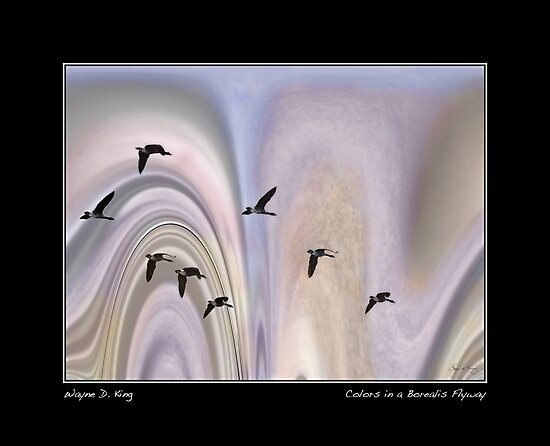
Colors in a Borealis Flyway

Taken from a Speech by Angeles Arrien and based on the works of Milton Olson

Fact 1
As each goose flaps its wings it creates an “uplift” for the birds that follow, By flying in a v formation, the entire flock adds 72 percent greater flying range than if a bird flew alone. LESSON : People who share a common direction and a sense of community can get where they are going quicker and easier because they are traveling on the thrust of one another.

Fact 2
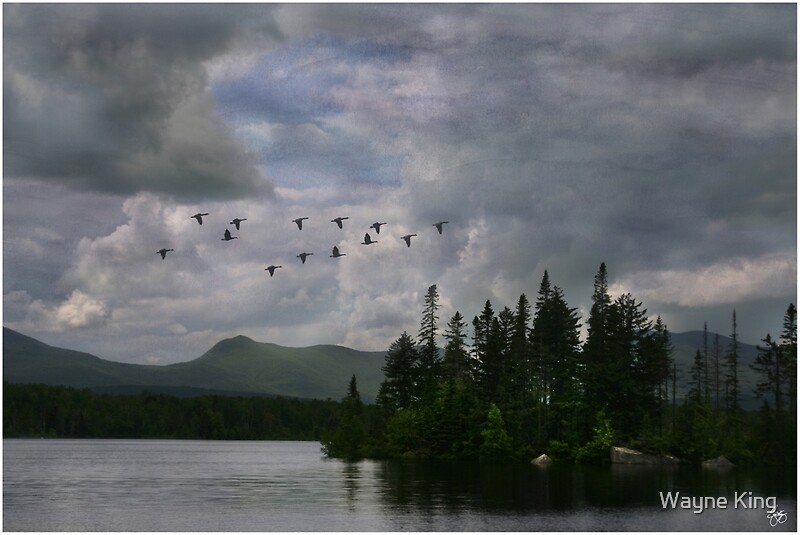
Goose Over Stinson Lake

When a goose falls out of formation, it suddenly feels the drag and resistance of flying alone. It quickly moves back into the formation to take advantage of the lifting power of the bird immediately in front of it. LESSON: If we have as much sense as a goose we stay in formation with those headed where we want to go.

Fact 3
When the lead goose tires, it rotates back into the formation and another goose flies the point position. LESSON: It pays to take turns doing the hard tasks and sharing leadership. As with geese, people are interdependent on each other’s skills, capabilities and unique arrangements of gifts,, talents and resources.

Fact 4
The geese flying in formation honk to encourage those up front to keep going. LESSON: We need to make sure our honking is encouraging. In groups where there is encouragement, the production is much greater.

Fact 5
When a goose gets sick, wounded or shot down, two geese drop out of formation and follow it down to help and protect it. They stay with the wounded goose until it is able to fly or dies. Then they launch out with another formation or catch up with their flock. LESSON: If we have as much sense as geese we will stand by one another in difficult times as well as when we are strong.


Painted Sky Over Jericho Lake
Lessons from Geese

community, Lessons from Geese, sense of community, unified vision, Jericho, Lake, Goose, hand painted

Thursday, December 3, 2015

King Images chosen for "Fauna 2015" International Exhibition

Los Angeles-based Linus Gallery recently announced the winners of a call for artists in a juried competition titled "Fauna". Among those images chosen were two images by New Hampshire-based artist Wayne King. Chosen for the exhibition were "Pelican Mindscape" and "Knee Deep in Zebras".

"Pelican Mindscape" is a mixed media image combining elements of photography and painting. The image was printed from a negative through textured glass, hand-painted using Marshall oils and then scanned for output using archival inks in an edition of 100 16" x 24" prints, signed by the artist and available at an affordable $195. Unsigned images are also available from RedBubble.com: http://rdbl.co/1M4cPky 


"Knee Deep in Zebras" is a composite monochrome image created from a series of images of Zebras. Three editions of 10 prints each are available, two edition are toned in Blue and Brown respectively with the final a straight monochrome. Original prints are available from the artist at a cost of $495.00 for a 16"x24" signed print. Unsigned open edition prints are also available from Fine Art America: http://bit.ly/1XK6mia.


"I am honored to have had two images selected in this prestigious competition" said King. "The Linus Gallery is one of the most active and progressive galleries on the Web. It may also provide an opportunity for a visit to Lost Angeles where my sister resides - a great added benefit!"


----------------------------------------------------
Special: Best Friend's Song Cards, posters and print. Reduced 50%. This beautiful piece with a quote from an unknown author makes a great gift as a poster, a print or cards. The quote "A friend is someone who knows the song in your heart and sings it back to you when you have forgotten how it goes."
http://bit.ly/1k5s16Z


Wednesday, October 21, 2015

Understanding the Natural World - Biomes

Understanding the Natural World

We all live in an area we call a Biome

What are Biomes?
Biomes are a way to divide the Earth's surface. These divisions are based on climate patterns, soil types, and the animals and plants that inhabit an area. There are biomes on dry land and in water. Every inch of the Earth's surface is a part of one or more biomes.

There are a couple of different ways to look at the number of biomes. Some like to divide biomes into five basic types: aquatic, forest, desert, tundra, and grassland. These five types of biomes can be further divided by differences in seasons or animal and plant species.

Aquatic Biome
The aquatic biome consists of any part of Earth that is covered with water. This includes freshwater and salt water. The aquatic biome can be further divided into freshwater biomes, marine biomes, wetland biomes, coral reef biomes, and estuaries. These subdivisions are based on the salt content of the water, the aquatic plants that live there, and the aquatic animals that thrive there.


Forest Biome
The forest biome is the largest and has a wide variety of plants, trees, animals, insects, and microscopic organisms. The major characteristic of the forest biome is its trees. About 30% of the Earth is considered a part of the forest biome. The forest biome is subdivided by its climate and types of trees present. These subdivisions are: the rainforest biome, temperate biome, chaparral biome, alpine biome, and taiga biome. 


Desert Biome
The desert biome has one major, distinguishing characteristic, the fact that it has very little vegetation. The climate is rather extreme depending on its location. The deserts of Africa are extremely hot during the winters and warm throughout the rest of the year. There are also cold deserts such as those in Antarctica. These deserts are extremely cold during the winter and cold during the other seasons.


Tundra Biome
Tundra biomes are the coldest places on Earth. They are similar to a cold desert except they receive less rainfall and contain different animals and plants. Even though the conditions are harsh, the tundra biome does have plant and animal habitats.


Grassland Biome
The grassland biome is made of rolling hills of various grasses. They receive just enough rain to sustain grass but not enough to grow many trees. There are a few trees that will grow in grasslands but sporadic wildfires keep them under control. There are two types of grassland, the savannas and temperate grasslands.


In which Biome do we Live?

We live in the forest biome in the sub-region known as Temperate. The Mountains of our region create a special ecology where some of the plants and trees from the cooler Boreal Biome begin to appear in the area. Our special region is known as The New England - Acadian Forest region.

Thursday, October 15, 2015

About Us

The Amateur Naturalist examines plants and trees (flora) and animals (fauna) of the Northeast Temperate biome.  It is designed for beginning naturalists. It is intended to cover the most common plants and trees of the Northeast region and to give amateur naturalists a thumbnail sketch of the plants, trees and critters that you are most likely to encounter on a walk in the woods or a hiking trail. We'll also give you a sneak peek at some of the most interesting uncommon plants, trees and animals just for fun.